A few weeks ago, ITV Cymru produced an edition of Y Byd ar Bedwar which focused on the crisis S4C is currently facing, and included figures from a poll they commissioned from YouGov. The programme is still available here for those who want to see it again.
Some of the poll figures which struck me were that:
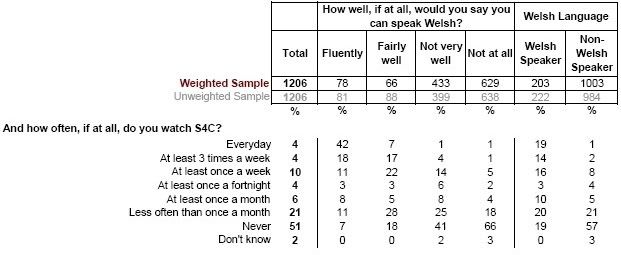
• 19% of Welsh speakers don't watch S4C at all
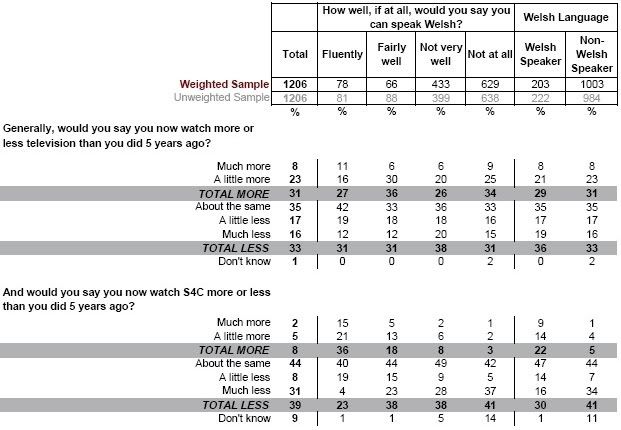
• 30% watched less TV than 5 years ago, but 39% watched less S4C
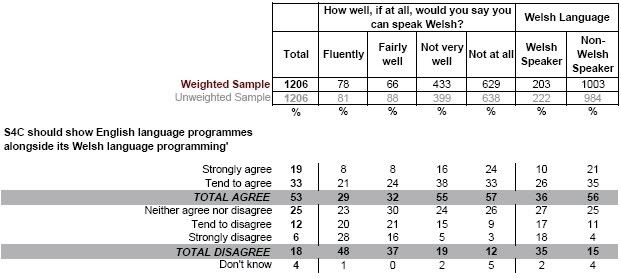
• 35% of Welsh speakers wanted S4C to remain wholly Welsh, but 36% of them thought that it should show English programmes too
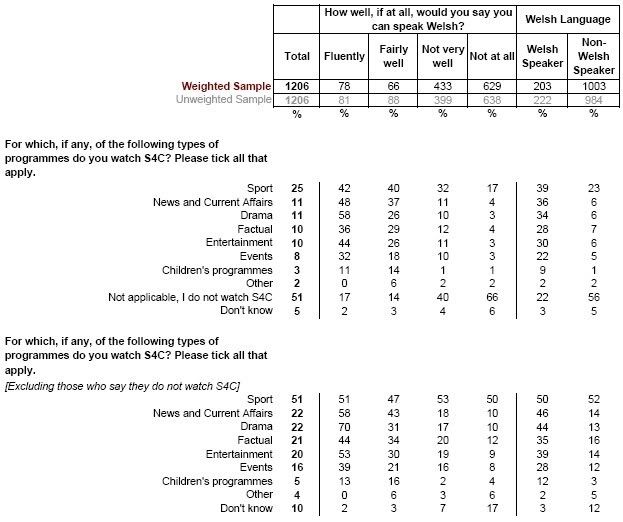
• Most people watched S4C for its sports coverage
It goes without saying that these were rather disappointing figures. So I asked YouGov for some additional information, particularly because one of the other polls they published based on the same data included a cross-break for fluency in Welsh. ITV have kindly given their permission for YouGov to publish this data and it is now available here.
YouGov in fact asked two separate questions on Welsh, in this order:
Can you understand, speak, read or write Welsh? Please tick all that apply.
• Understand spoken Welsh
• Speak Welsh
• Read Welsh
• Write Welsh
• None of the above
How well, if at all, would you say you can speak Welsh?
• Fluently
• Fairly well
• Not very well
• Not at all
The first question was chosen because it is identical to the question asked in the census, and this was used to weight the raw data, but the second question gives a rather fuller picture of people's ability.
In answer to the first question, 222 out of 1206 or 18.4% said they could speak Welsh, which was then weighted to 16.8%. (If this seems low, it is probably because YouGov asked adults, but the census figures are for all people over 3 years old, and the highest percentage of Welsh speakers is for those at school.) But in answer to the second, the raw percentages for ability to speak Welsh were:
Fluently ... 6.7%
Fairly well ... 7.3%
Not very well ... 33.1%
Not at all ... 52.9%
What this shows is that there is quite a flexible "middle ground" in which people's views can be characterized as falling into one of two responses, either:
"I am a Welsh speaker, but I don't speak Welsh very well."
or
"I don't speak Welsh very well, therefore I can't really call myself a Welsh speaker."
The purpose of giving this explanation is in order to help us understand the more detailed information within the survey. The programme itself only made mention of the breakdown between Welsh speakers and non Welsh speakers based on the first question. In fact it is almost certain that the programme makers did not know what the cross-break (to use the jargon) for fluency in Welsh was, since that information has only been put together in response to my request.
For that reason, I want to stress that I am not accusing ITV of presenting misleading information. The figures they quoted are accurate ... but just not as helpful as they could have been. So with this in mind I now want to look again at what the more detailed information shows us.
How many Welsh speakers watch S4C?

So the headline figure that 19% of the Cymry Cymraeg don't watch S4C gets reduced to only 7% of those who speak the language fluently. 93% of fluent Welsh speakers watch S4C at least sometimes, and 71% watch S4C at least once a week.
Do we watch S4C more or less that we did 5 years ago?

The way the figures were presented on Y Byd ar Bedwar was that the fall in S4C viewers was worse that the general fall in television viewing. So these more detailed figures are quite startling. Yes, it is true that people generally watch less TV than we did five years ago, but the percentage of fluent Welsh speakers who watch S4C has actually gone up ... 36% watch S4C more than before, only 23% less.
What do we watch on S4C?

It is of course true that most people who watch S4C watch it for sport, but for those who are fluent in Welsh, sport is not the main type of programme watched. Drama, News and Current Affairs, and Entertainment programming are each higher up the list than sport.
Do Welsh speakers want English language programmes on S4C?

One of the major points made on the programme was that even Welsh speakers, even though only by 36% to 35%, wanted S4C to remain wholly Welsh. But the more detailed figures show that this was certainly not the opinion of those who speak Welsh fluently or even fairly well.
-
I've highlighted these points because they go some way to explain the more surprising figures presented on the programme. S4C is a minority channel, primarily aimed at those who speak Welsh ... although of course open to anybody who wants to watch.
What these figures seem to show is that S4C is actually doing a very good job of providing a range of Welsh language programmes for those who want drama, entertainment, news, current affairs in Welsh rather than in English. The percentage of those fluent in Welsh who watch S4C is very high indeed, and these people watch more S4C now than we used to five years ago. Surely that is a mark of success.