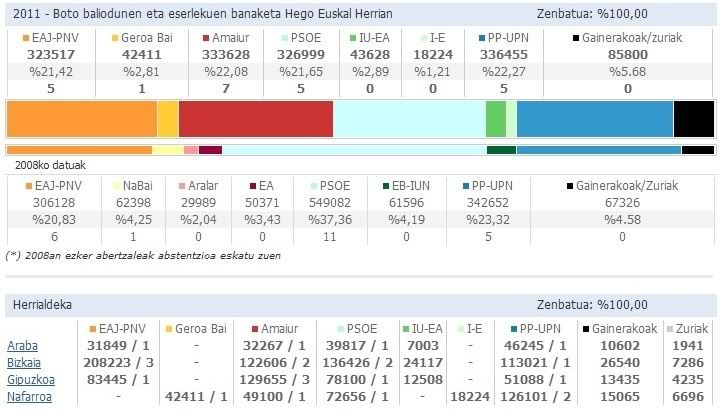
The results of the Spanish general election are now clear, if not quite final, with the right wing Partido Popular winning 186 of the 350 seats in the lower house. This is bad news for those whose politics are generally to the left, and also bad news for those who don't support a centralized Spanish state. The 2011 result is on the left, the 2008 result on the right.

I'm sure there'll be plenty in the UK media on the implications of this for Spain, but not much on the particular implications for Catalunya and Euskadi. So let me try and put that right.
The Catalan perspective
The big hope of the centre-right nationalist CiU in Catalunya was that Mariano Rajoy would not get an overall majority and would need to do a deal with them to form a government. That deal would have come at the price of greater fiscal autonomy for Catalunya. But because the PP have an overall majority, that isn't going to happen.
But this is not necessarily a bad thing for those who want to see Catalunya become independent, for it simply removes one of the options. For Catalunya, the situation is exactly the same as for Scotland: a big majority of the people want greater autonomy, and many would be probably satisfied with a substantially greater degree of autonomy as part of either Spain or the UK rather than independence. However, if that middle option is taken off the table, support for independence becomes greater. With a PP government in Madrid, the option of moving towards a federal Spain has been removed, for the PP are the archetypal Spanish nationalist party and if anything will move to re-centralize rather than federalize Spain. The current economic crisis will give them all the pretext they need.
These are the results for Catalunya:
CiU ... 29.35% (was 20.93%) 16 seats (was 10)
PSC-PSOE ... 26.64% (was 45.93%) 14 seats (was 25)
PP ... 20.72% (was 16.40%) 11 seats (was 8)
ICV-EUiA ... 8.09% (was 4.92%) 3 seats (was 1)
ERC (+ RCAT) ... 7.06% (was 7.83%) 3 seats (was 3)
The pattern here is a huge collapse in the Spanish Socialist vote, more marked in Catalunya that in the Spanish as a whole (where it fell from 43.87% to 28.73%). But although some of that vote went to the PP, a much larger part of the swing from left to right went to CiU. They have every reason to be very pleased with this result, for a gain of six seats was much larger than the gain of two that was being predicted when I wrote this post last weekend.
But this won't really get them anything they want from Madrid, and certainly not the same degree of fiscal autonomy as the four Basque provinces enjoy. So what is Artur Mas's plan B? He personally is in favour of independence, as is much of the CiU leadership, though perhaps more so on the C (Convergence) side than the U (Union) side. The majority of party supporters now want independence too. So, at least as I see it, the next few months could see the party's official policy shift from pro-autonomy within Spain to pro-independence. Artur Mas will be in a very strong position to push this through because of the gains made by CiU in this election, and the new wave of austerity measures and a clampdown on regional autonomy from the Madrid government will only serve to increase the alienation between Spain and Catalunya yet further. This opportunity is too good to miss, but will he and his party be up to it?
The Basque Perspective
A week ago, the polls were predicting an almost equal four way split between the two Spanish parties (the PP and PSE-PSOE), and the two Basque nationalist parties (the centre-right EAJ-PNV and the new pro independence left coalition Amaiur. In terms of percentages, the polls were just about right. But in terms of seats won, Amaiur have come from nowhere to become the biggest party with 7 of the 23 seats. This is the graphic from Gara:
This shows the results for all four Basque provinces in Spain, rather than just the three in the Autonomous community. The situation is complicated a little by the fact that in 2008 NaBai was a broad Basque nationalist coalition of both left and right; but in 2011 the EAJ-PNV fought as Geroa Bai while the left stood as part of Amaiur.
EAJ-PNV (+ Geroa Bai) ... 24.23% (was 25.08%) 6 seats (was 7)
PP ... 22.27% (was 23.32%) 5 seats (was 5)
Amaiur ... 22.08% (EA and Aralar were 5.47%) 7 seats (was 0)
PSE-PSOE ... 21.65% (was 37.36%) 5 seats (was 11)
Again, there is a huge fall in the Spanish Socialist vote, but virtually all of it has gone to the pro-independence left. In contrast to what's happened in Spain, there has been no appreciable swing from left to right in Euskadi. The PP's vote has, amazingly, managed to go down; though the EAJ-PNV vote has probably increased slightly (because some of NaBai's vote in 2008 would have come from left leaning Basque nationalists). The numbers of seats won doesn't quite match the percentages because smaller provinces have proportionally more seats than larger provinces.
This is a stunning result for the pro-independence left in Euskadi, but what will it lead to?
7 seats won't make a blind bit of difference to a right wing Spanish government in Madrid ... nor will the combined Basque nationalist total of 13 out of 23 seats (or 11 out of 18 seats excluding Nafarroa). Instead, this is about the normalization of politics in the post-ETA era. The Spanish State has finally run out of excuses to ban the pro-independence left from standing in elections, so we are beginning to see just how strong that support is, and therefore how strong the combined support for independence is from both the left and right of the political spectrum.
As today is Catalunya's National Day, I thought a rousing version of one of the better national anthems in the world would be in order.
It's called Els Segadors, which means The Reapers, and is a song of breaking the chains and driving away the conceited and contemptful Spanish.
With the way Spain is treating the Catalans, I wouldn't be surprised to see a repeat of last July, when more than a million people were on the streets of Barcelona. We can be with them in spirit.
Thanks to Col·lectiu Emma, I've just read an interesting article by Paddy Woodworth, comparing what is happening in Catalunya with what is happening in Euskadi, the Basque Country, a place with which he seems to be well acquainted.
Madrid's nightmare
It's worth reading alongside a contrasting article that appeared just over a week ago in Spiegel Online.
Zero Tolerance in the Fight against ETA
One of the great unanswerable questions of the last century is whether a country like Ireland would ever have won its independence from the United Kingdom if it had not fought a war for it; or whether the UK would ever have relinquished its strategic interest in the north if people hadn't been prepared to fight for it. We in Wales and Scotland can only consider ourselves fortunate that we can be independent whenever we vote for it.
But once a fight for independence has become violent—or indeed the fight to prevent it, for in any armed conflict both sides use violence—it requires no little effort and commitment to then fight by peaceful and democratic means.
-
To my mind, Der Spiegel's article reads too much like a vanity piece for Patxi Lopez. As I read the situation in Euskadi, the Basques will undoubtedly vote for independence whenever Spain allows them to do so ... that's why Spain refuses to let them exercise that choice. They have been able to portray far too many Basque leaders calling for independence as terrorist sympathizers, imprisoning them and banning their parties.
But Catalunya, like Wales and Scotland, has no real history of violence in the fight for independence, so the issue is not clouded in the same was as it has been in Ireland and Euskadi. If Catalunya can gain its independence by peaceful means (the onus being on the Spanish, because they're the ones who might use military force to prevent it) it will then be hard for them not to let Euskadi do the same.
And if Scotland wins its independence, it might in turn be the catalyst that triggers Irish reunification. For the unionist community has far stronger cultural and social links with Scotland than with the RUK. And their loyalty to the crown will be severely tested when a queen they respect and can look up to passes away to be replaced by a son who cannot be looked up to.
I've been meaning to write something on the situation in Catalunya for some time, but the longer I left it, the more "out of the news" it became, to the point where I'd have to explain things over again. However, the massive demonstration on 10 July in support of Catalunya's right to decide its own future has brought the political situation in Catalunya back into the spotlight.
The demonstration was sparked by the decision of the Spanish Constitutional Tribunal (TC) to declare that some of the articles in Catalunya's Statute of Autonomy are unconstitutional. The Statute was passed in 2006 to replace the earlier version of 1979, which was part of Spain's transition to democracy after Franco's death in 1975. It was presented by the Catalan Parliament with support from all parties except the Partido Popular, then passed by the Spanish Parliament after amendment by them, then finally ratified by a referendum. Although the vote in favour was high (73.2% to 20.6% in favour) the turnout was 48.9% ... which either reflected the degree to which it had been watered down or showed that Catalans were not very interested in their constitutional position, depending on one's political standpoint.
The Statute had been challenged by the Partido Popular in the Constitutional Tribunal on matters relating to Catalunya's autonomy, and by surrounding autonomous communities on other matters particularly to do with finance. Although the "headline issue" was whether Catalans were allowed to consider themselves a nation or not, the ruling had many other facets, including:
• the right of the Catalan Government to have a bilateral relation with the Spanish Government
• the obligation to know Catalan language in order to work in the public sector
• the Catalan Supreme Court of Justice as the highest court for certain kinds of laws
• minimum levels of infrastructure investment and limit on the degree of fiscal equalization
Some of these rulings are inconsistent in that, for example: the bilateral relations are essentially similar to those enjoyed by Euskadi and Navarre and the proposed Justice Council of Catalonia is modelled on what other communities such as Andalusia already have. The fiscal provisions were intended to limit the amount that could be transferred from Catalunya to the remainder of Spain (it is the richest area in Spain second only to Euskadi) and to guarantee a minimum share of infrastructure investment, following the German model. These details are taken from this article, which is the most complete account of the ruling I have been able to find.
For information, it's probably worthwhile to look at the political parties in Catalunya, what they stand for, and their level of support. Ranked in terms of their vote in the 2006 election to the Catalan Parliament they are:
• CiU - Convergència i Unió ... centre-right, pro-autonomy (31.5%)
• PSC - Partit dels Socialistes de Catalunya ... centre left (26.8%)
• ERC - Esquerra Republicana de Catalunya ... left, pro-independence (14.0%)
• PP - Partido Popular ... right, anti-autonomy, pro-Spain (10.7%)
• ICV - Iniciativa per Catalunya Verds ... coalition of left and Greens (9.5%)
• Cs - Ciutadans ... left, anti-autonomy, pro-Spain (3.0%)
The current Catalan government is made up of a broad left alliance between the PSC, ERC and ICV. This coalition was formed after the 2004 election, and the ERC's participation in government was at the price of securing the new Statute of Autonomy with a PSC that had always been lukewarm about it before. Negotiations between Barcelona and Madrid were also helped by the fact that the socialist Zapatero had just become First Minister of Spain. Obviously CiU also wanted a stronger SoA, meaning that it had more than 80% support in the Catalan Parliament.
Now that several articles of the SoA have been struck down or amended, those same four parties formed the backbone of the demonstration on Saturday, along with a host of civic leaders and other prominent members of Catalan society. The principles that united them were that any constitutional question mark over the new SoA should have been sorted out when the it was being considered by the Catalan and Spanish Parliaments, and certainly before being approved in a referendum; and that it was up to the people of Catalunya to decide their constitutional future, not the Spanish State.
In all probability the march was organized on the basis that it is for the people of Catalunya to decide their future, and not to have something they have already approved retrospectively amended. However it was probably a surprise to some of the organizers that there were so many pro-independence banners in the crowd. It wasn't organized as a pro-independence march ... but that is definitely what it turned out to be. So it is worth considering why the public mood in Catalunya has shifted from respect for the enhanced autonomy the Catalans thought they had to independence. Up until now, the only pro-independence party has been the ERC. They are the party that Plaid Cymru and the SNP work with in the European Parliament as part of the EFA.
The current rise of support for independence probably springs from the series of non-official independence referendums that started with the one in Arenys de Munt in September. There was a second round in December. Both these resulted in over 90% support for independence from those who voted, making turnout the critical factor. In the second round the turnout was 27.3%, which would have been enough to secure a victory if the turnout had been about 52.4%. And if anyone thinks I was being over-clever with my maths, it was gratifying to see Artur Mas, leader of the CiU, echo what I had said. But subsequent rounds of voting have been more disappointing for those wanting independence, with the turnout falling to 20.2% in April and most recent round having a turnout of 13.7%.
There are two ways of viewing this. For unionists, it is a demonstration that support for independence is low, particularly in the more urban areas. However it should be noted that these referendums have been organized unofficially by volunteers without any the use of any official resources, most notably in terms of information and publicity. One useful parallel would be to compare these turnouts with the turnout for an official referendum and, as luck would have it, there was one of these in Barcelona in May this year on the future of the Avinguda Diagonal, one of Barcelona's main thoroughfares. Despite all the publicity events the use of official facilities and a budget of over €3m, the turnout in that referendum was only 12%.
But even so, there was a general sense of disappointment, that the independence referendums had not resulted in a higher turnout. However a new possibility has opened up, because it is now possible to organize official referendums on citizens' initiatives if they can collect 25,000 signatures. The Catalan government has allowed the initiative to go ahead, and signatures are being collected. There seems little doubt in my mind that the required number of signatures will be gathered, but what happens after that is more problematic. A similar referendum in Euskadi in 2008 was banned by the Spanish State.
The third development is that two more pro-independence groups have recently been formed. The first, Reagrupament, set itself up with the specific aim of either electing enough deputies to the Catalan Parliament on pro-independence mandate—either under its own name or by getting other parties to adopt that specific policy platform—to declare independence. The thinking behind this is that the Spanish won't let Catalans vote in a referendum, therefore declaring unilateral independence allows them to set up a referendum without Spanish interference. Other countries, as well as the EU and UN, would be almost certain to recognize that independence if it was confirmed in a properly held referendum, and the Spanish would not dare to take control by military force.
For some time there was speculation that Joan Laporta (the former chairman of Barcelona FC and unambiguously pro-independence) would join or even become co-leader of Reagrupament, but he has decided to set up his own party, Democràcia Catalana, as a vehicle by which to become President of Catalunya. Of course it is not out of the question for the two groups to form an alliance for the election.
Against that melting pot of possibilities, the thing that matters more than anything is public opinion. I pointed to a poll that showed 51% in favour of independence last December but didn't get round to mentioning the another poll conducted for El Periodico. But it just so happens that they have done a follow up poll and the results of both are:
If an official referendum on
independence for Catalonia was held,
would you vote for or against?
Parliament has accepted an initiative to hold an official referendum on
independence. Do you think it appropriate to hold it at the moment?
Do you think he the necessary signatures (25,000) will be collected
to progress it?
If the signatures are obtained, do you think that the Catalan Parliament
would approve holding the referendum?
Do you think the Spanish government would allow this referendum to
be held?
Apart from the headline figure showing a margin of 48.1% to 35.3% in favour of independence, what seems most interesting to me is the breakdown by political party. Of course supporters of ERC are solidly in favour of independence, and those of the PP and Cs are solidly against; but the other parties are more interesting.
-
The majority of CiU supporters, by a margin of almost 2:1, are in favour of independence (and the same was true in the breakdowns for last December). Now CiU has always been a Catalan nationalist party, but in favour of greater autonomy for Catalunya in Spain rather than independence. So the choices for the CiU leadership are stark, for no political party can stand against something that most of its supporters want. If CiU now shifted its policy to one of pro-independence, the chance of independence would grow dramatically because they are the biggest party in Catalunya, even though kept out of government by a coalition of the three left leaning parties. If it doesn't shift its policy, there is every chance that voters could shift from CiU to either Reagrupament or to Laporta's new party, which would position themselves on the centre right so as to catch those votes, knowing that left-leaning independence supporters would vote ERC.
It's a choice that CiU would much rather not have to make. So it is concentrating its effort, along with the PSC, on trying to get the Constitution of Spain changed so that there is no contradiction between it and the 2006 SoA. My opinion is that it's worth giving it a go for the sake of due process (and the ERC and ICV will join them in that) but that it won't happen. That's largely because public opinion in Spain has developed a markedly anti-Catalan streak, as I mentioned in this post.
-
Of the parties of the left, opinion among ICV supporters is fairly evenly divided, but with a very high percentage of don't knows. However that probably doesn't matter too much one way or the other for a party with less than 10% support. The PSC, on the other hand, has 27% support. Its problem is working out its relationship with its sister party in Spain, the PSOE. The situation is rather like that between Wales and Scotland and the UK. The PSOE needs PSC support to form a government in Madrid in just the same way as Labour needs its Welsh and Scottish MPs to have any chance of forming a government in Westminster.
So the chances of the PSC leadership agreeing to independence for Catalunya are very small, even though more than a third of their supporters want it.
-
The final factor is that the next Catalan elections will be held in September this year. Things are very fluid, and I'm finding it hard to pick up on all the nuances of what is happening.
Well, that's the background as I see it. And even though things are complicated, you wouldn't want me not to make some predictions ... so here goes.
The referendum initiative will get 25,000 votes without any trouble. The PSC and CiU will try and do nothing about it until after the elections because they want people to vote primarily along the left/right lines for which they are the biggest parties respectively. Therefore the name of the game for those who want independence is to make independence a greater issue than the normal left/right divide of everyday politics. If ERC, Reagrupament and Laporta can make this the burning issue of the summer, UiC will be under great pressure to decide whether to take a pro-independence stance for fear of losing votes if they don't. The size of the demonstration last weekend suggests it will be, but the UiC are doing very well in recent polls (over 40%) and may well think that they don't need to change anything.
I predict that UiC will commit themselves to holding a referendum. That's easy, but the big question is what position they will take when (for there's no question of it being an if) Spain refuses to let it go ahead, as they did with the Ibarretxe referendum in Euskadi in 2008. They not commit themselves, and that will lose them votes to Reagrupament and Laporta if independence can be made the main issue of the election.
Even though I would be disappointed to see them fall short, ERC, Reagrupament and Laporta will only get about 40% of the seats in the new Parliament. Because of CiU's previous commitment to a referendum it will be voted though in Parliament, but will be blocked by Spain. However neither CiU nor the PSC will be able to form a government that is not dependent on pro-independence parties of some political hue, and CiU deputies will not feel able to vote for a UDI because they were not elected on that mandate. So new elections will be necessary in Spring 2011. This time there will be nothing for the CiU to be ambiguous about, and they will have to adopt a pro-independence stance because all other avenues will be closed. The majority in the new Parliament will have been elected on a pro-independence mandate and will declare UDI, with a confirmatory referendum to be held within a few months.
It will be won.
I've been meaning to write something on the situation in Catalunya for some time, but the longer I left it, the more "out of the news" it became, to the point where I'd have to explain things over again. However, the massive demonstration on 10 July in support of Catalunya's right to decide its own future has brought the political situation in Catalunya back into the spotlight.
The demonstration was sparked by the decision of the Spanish Constitutional Tribunal (TC) to declare that some of the articles in Catalunya's Statute of Autonomy are unconstitutional. The Statute was passed in 2006 to replace the earlier version of 1979, passed as part of Spain's transition to democracy after the death of Franco in 1975. It was presented by the Catalan Parliament with support from all parties except the Partido Popular, then passed by the Spanish Parliament after amendment by them, then finally ratified by a referendum. Although the vote in favour was high (73.2% to 20.6% in favour) the turnout was 48.9% ... which either reflected the degree to which it had been watered down or showed that Catalans were not very interested in their constitutional position, depending on one's political standpoint.
The Statute had been challenged by the Partido Popular in the Constitutional Tribunal on matters relating to Catalunya's autonomy, and by surrounding autonomous communities on other matters particularly to do with finance. Although the "headline issue" was whether Catalans were allowed to consider themselves a nation or not, the ruling had many other facets, including:
• the right of the Catalan Government to have a bilateral relation with the Spanish Government • the obligation to know Catalan language in order to work in the public sector • the Catalan Supreme Court of Justice as the highest court for certain kinds of laws • minimum levels of infrastructure investment and limit on the degree of fiscal equalization
Some of these rulings are inconsistent in that, for example: the bilateral relations are essentially similar to those enjoyed by Euskadi and Navarre and the proposed Justice Council of Catalonia is modelled on what other communities such as Andalusia already have. The fiscal provisions were intended to limit the amount that could be transferred from Catalunya to the remainder of Spain (it is the richest area in Spain second only to Euskadi) and to guarantee a minimum share of infrastructure investment, following the German model. These details are taken from this article, which is the most complete account of the ruling I have been able to find.
For information, it's probably worthwhile to look at the political parties in Catalunya, what they stand for, and their level of support. Ranked in terms of their vote in the 2006 election to the Catalan Parliament they are:
• CiU - Convergència i Unió ... centre-right, pro-autonomy (31.5%)
• PSC - Partit dels Socialistes de Catalunya ... centre left (26.8%)
• ERC - Esquerra Republicana de Catalunya ... left, pro-independence (14.0%)
• PP - Partido Popular ... right, anti-autonomy, pro-Spain (10.7%)
• ICV - Iniciativa per Catalunya Verds ... coalition of left parties and the Greens (9.5%)
• Cs - Ciutadans ... left, anti-autonomy, pro-Spain (3.0%)
The current Catalan government is made up of a broad left alliance between the PSC, ERC and ICV. This coalition was formed after the 2004 election, and the ERC's participation in government was at the price of securing the new Statute of Autonomy with a PSC that had always been lukewarm about it before. Negotiations between Barcelona and Madrid were also helped by the fact that the socialist Zapatero had just become First Minister of Spain. Obviously CiU also wanted a stronger SoA, meaning that it had more than 80% support in the Catalan Parliament.
Now that several articles of the SoA have been struck down or amended, those same four parties formed the backbone of the demonstration on Saturday, along with a host of civic leaders and other prominent members of Catalan society. The principles that united them were that any constitutional question mark over the new SoA should have been sorted out when the it was being considered by the Catalan and Spanish Parliaments, and certainly before being approved in a referendum; and that it was up to the people of Catalunya to decide their constitutional future, not the Spanish State.
In all probability the march was organized on the basis that it is for the people of Catalunya to decide their future, and not to have something they have already approved retrospectively amended. However it was probably a surprise to some of the organizers that there were so many pro-independence banners in the crowd. It wasn't organized as a pro-independence march ... but that is definitely what it turned out to be. So it is worth considering why the public mood in Catalunya has shifted from respect for the enhanced autonomy the Catalans thought they had to independence. Up until now, the only pro-independence party has been the ERC. They are the party that Plaid and the SNP work with in the European Parliament as part of the EFA.
The current rise of support for independence probably springs from the series of non-official independence referendums that started with the one in Arenys de Munt in September. There was a second round in December. Both these resulted in over 90% support for independence from those who voted, making turnout the critical factor. In the second round the turnout was 27.3%, which would have been enough to secure a victory if the turnout had been about 52.4%. And if anyone thinks I was being over-clever with my maths, it was gratifying to see Artur Mas, leader of the CiU, echo what I had said. But subsequent rounds of voting have been more disappointing for those wanting independence, with the turnout falling to 20.2% in April and most recent round having a turnout of 13.7%.
There are two ways of viewing this. For unionists, it is a demonstration that support for independence is low, particularly in the more urban areas. However it should be noted that these referendums have been organized unofficially by volunteers without any the use of any official resources, most notably in terms of information and publicity. One useful parallel would be to compare these turnouts with the turnout for an official referendum and, as luck would have it, there was one of these in Barcelona in May this year on the future of the Avinguda Diagonal, one of Barcelona's main thoroughfares. Despite all the publicity events the use of official facilities and a budget of over €3m, the turnout in that referendum was only 12%.
But even so, there was a general sense of disappointment, that the independence referendums had not resulted in a higher turnout. However a new possibility has opened up, because it is now possible to organize official referendums on citizens' initiatives if they can collect 25,000 signatures. The Catalan government has allowed the initiative to go ahead, and signatures are being collected. There seems little doubt in my mind that the required number of signatures will be gathered, but what happens after that is more problematic. A similar referendum in Euskadi in 2008 was banned by the Spanish State.
The third development is that two more pro-independence groups have recently been formed. The first, Reagrupament, set itself up with the specific aim of either electing enough deputies to the Catalan Parliament on pro-independence mandate—either under its own name or by getting other parties to adopt that specific policy platform—to declare independence. The thinking behind this is that the Spanish won't let Catalans vote in a referendum, therefore declaring unilateral independence allows them to set a referendum up without Spanish interference. Other countries, as well as the EU and UN, would be almost certain to recognize that independence if it was confirmed in a properly held referendum, and the Spanish would not dare to take control by military force.
For some time there was speculation that Joan Laporta (the former chairman of Barcelona FC and unambiguously pro-independence) would join or even become co-leader of Reagrupament, but he has decided to set up his own party, Democràcia Catalana, as a vehicle by which to become President of Catalunya. Of course it is not out of the question for the two groups to form an alliance for the election.
Against that melting pot of possibilities, the thing that matters most is public opinion. I pointed to a poll that showed 51% in favour of independence last December but didn't get round to mentioning the another poll conducted for El Periodico. But it just so happens that they have done a follow up poll and the results of both are:
If an official referendum on
independence for Catalonia was held,
would you vote for or against?
Parliament has accepted an initiative to hold an official referendum on
independence. Do you think it appropriate to hold it at the moment?
Do you think he the necessary signatures (25,000) will be collected
to progress it?
If the signatures are obtained, do you think that the Catalan Parliament
would approve holding the referendum?
Do you think the Spanish government would allow this referendum to
be held?
Apart from the headline figure showing a margin of 48.1% to 35.3% in favour of independence, what seems most interesting to me is the breakdown by political party. Of course supporters of ERC are solidly in favour of independence, and those of the PP and Cs are solidly against; but the other parties are more interesting.
The majority of CiU supporters, by a margin of almost 2:1, are in favour of independence (and the same was true in the breakdowns for last December). Now CiU has always been a Catalan nationalist party, but in favour of greater autonomy for Catalunya in Spain rather than independence. So the choices for the CiU leadership are stark, for no political party can stand against something that most of its supporters want. If CiU now shifted its policy to one of pro-independence, the chance of independence would grow dramatically because they are the biggest party in Catalunya, even though kept out of government by a coalition of the three left leaning parties. If it doesn't shift its policy, there is every chance that voters could shift from CiU to either Reagrupament or to Laporta's new party, which would position themselves on the centre right so as to catch those votes, knowing that left-leaning independence supporters would vote ERC.
It's a choice that CiU would much rather not have to make. So it is concentrating its effort, along with the PSC, on trying to get the Constitution of Spain changed so that there is no contradiction between it and the 2006 SoA. My opinion is that it's worth giving it a go for the sake of due process (and the ERC and ICV will join them in that) but that it won't happen. That's largely because public opinion in Spain has developed a markedly anti-Catalan streak, as I mentioned in this post.
-
Of the parties of the left, opinion among ICV supporters is fairly evenly divided, but with a very high percentage of don't knows. However that probably doesn't matter too much one way or the other for a party with less than 10% support. The PSC, on the other hand, has 27% support. Its problem is working out its relationship with its sister party in Spain, the PSOE. The situation is rather like that between Wales and Scotland and the UK. The PSOE needs PSC support to form a government in Madrid in just the same way as Labour needs its Welsh and Scottish MPs to have any chance of forming a government in Westminster.
So the chances of the PSC leadership agreeing to independence for Catalunya are very small, even though more than a third of their supporters want it.
-
The final factor is that the next Catalan elections will be held in September this year. Things are very fluid, and I'm finding it hard to pick up on all the nuances of what is happening.
Well, that's the background as I see it. And even though things are complicated, you wouldn't want me not to make some predictions ... so here goes.
The referendum initiative will get 25,000 votes without any trouble. The PSC and CiU will try and do nothing about it until after the elections because they want people to vote primarily along the left/right lines for which they are the biggest parties respectively. Therefore the name of the game for those who want independence is to make independence a greater issue than the normal left/right divide of everyday politics. If ERC, Reagrupament and Laporta can make this the burning issue of the summer, UiC will be under great pressure to decide whether to take a pro-independence stance for fear of losing votes if they don't. The size of the demonstration last weekend suggests it will be.
I predict that UiC will commit themselves to holding a referendum. But the big question is what position they will take when (for there's no question of it being an if) Spain refuses to let it go ahead, as they did with the Ibarretxe referendum in Euskadi in 2008. They will fudge the issue. That will lose them votes to Reagrupament and Laporta.
Even though I would be disappointed to see them fall short, ERC, Reagrupament and Laporta will only get about 40% of the seats in the new Parliament, and Laporta will be elected President. Because of CiU's previous commitment to a referendum, it will be voted though but will be blocked by Spain. However neither CiU nor the PSC will be able to form a government that is not dependent on pro-independence parties, and CiU deputies will not feel able to vote for a UDI because they were not elected on that mandate and would be split on the issue anyway. So new elections will be necessary in Spring 2011. This time there will be nothing for the CiU to be ambiguous about, and they will either choose to adopt a pro-independence stance or be reduced to a rump. The majority in the new Parliament will have been elected on a pro-independence mandate and will declare UDI, with a confirmatory referendum to be held within six months.
It will be won.
I've been meaning to write something on the situation in Catalunya for some time, but the longer I left it, the more "out of the news" it became, to the point where I'd have to explain things over again. However, the massive demonstration on 10 July in support of Catalunya's right to decide its own future has brought the political situation in Catalunya back into the spotlight.
Picture of demo
That demonstration was sparked by the decision of the Spanish Constititional Tribunal (TC) to declare that some of the articles in Catalunya's Statute of Autonomy are unconstitutional. The Statute was passed in 2006 to replace the earlier version of 1979, passed as part of Spain's transition to democracy after the death of Franco in 1975. It was presented by the Catalan Parliament with support from all parties except the Partido Popular, then passed by the Spanish Parliament after amendment by them, then finally ratified by a referendum. Although the vote in favour was high (73.2% to 20.6% in favour) the turnout was 48.9% ... which either reflected the degree to which it had been watered down or showed that Catalans were not very interested in their constitutional position, depending on one's political standpoint.
The Statute had been challenged by the Partido Popular in the Constititional Tribunal on matters relating to Catalunya's autonomy, and by surrounding autonomous communities on other matters particularly to do with finance. Although the "headline issue" was whether Catalans were allowed to consider themselves a nation or not, the ruling had numerous practical consequences:
At this stage it might be worthwhile to look at the political parties in Catalunya, what they stand for, and their level of support. Ranked in terms of their vote in the 2006 election to the Catalan Parliament they are:
• CiU - Convergència i Unió ... centre-right, pro-autonomy (31.5%) • PSC - Partit dels Socialistes de Catalunya ... centre left (26.8%) • ERC - Esquerra Republicana de Catalunya ... left, pro-independence (14.0%) • PP - Partido Popular ... right, anti-autonomy, pro-Spain (10.7%) • ICV - Iniciativa per Catalunya Verds ... coalition of left parties and the Greens (9.5%) • Cs - Ciutadans ... left, anti-autonomy, pro-Spain (3.0%)
The current Catalan government is made up of a broad left alliance between the PSC, ERC and ICV. This coalition was formed after the 2004 election, and the ERC's participation in government was at the price of securing the new Statute of Autonomy with a PSC that had always been lukewarm about it before. Obviously the CiU also wanted a stronger SoA, meaning that it had more than 80% support in the Catalan Parliament.
Now that several articles of the SoA have been struck down or amended, those same four parties formed thae backbone of the demonstration on Saturday, along with a host of civic leaders and other prominent members of Catalan society. The principles that united them were that any constitutional question mark over the new SoA should have been sorted out when the it was being considered by the Catalan and Spanish Parliaments, and certainly before being approved in a referendum; and that it was up to the people of Catalunya to decide their constitutional futurem, not the Spanish State.
In all probability the march was organized on the basis that it is for the people of Catalunya to decide their future, and not to have something they have already approved retrospectively amended. However it was probably a surprise to some of the organizers that there were so many pro-independence banners in the crowd. It wasn't organized as a pro-independence march ... but that is definitely what it turned out to be. So it is worth considering why the public mood in Catalunya has shifted from respect for the enhanced autonomy the Catalans thought they had to independence. Up until now, the only pro-independence party has been the ERC. They are the party that Plaid and the SNP work with in the European Parliament as part of the EFA.
The current rise of support for independence probably springs from the series of non-official independence referendums that started with the one in Arenys de Munt in September. There was a second round in December. Both these resulted in over 90% support for independence from those who voted, making turnout the critical factor. In the second round the turnout was 27.3%, which would have been enough to secure a victory if the turnout had been about 52.4%. And if anyone thinks I was being over-clever with my maths, it was gratifying to see Artur Mas, leader of the CiU, echo what I had said. But subsequent rounds of voting have been more disappointing for those wanting independence, with the turnout falling to 20.2% in April and most recent round having a turnout of 13.7%.
There are two ways of viewing this. For unionists, it is a demonstration that support for independence is low, particularly in the more urban areas. However it should be noted that these referenda have been organized unofficially by volunteers without any the use of any official resources, most notably in terms of information and publicity. One useful parallel would be to compare these turnouts with the turnout for an official referendum and, as luck would have it, there was one of these in Barcelona in May this year on the future of the Avinguda Diagonal, one of Barcelona's main throughfares. Despite all the publicity events the use of official facilities and a budget of ----------, the turnout in that referendum was only 12%.
-
But even so, there was a general sense of disappointment, that the indepndence referenda had not resulted in a higher turnout. However a new possibility has opened up, because it is now possible to organize official referendums on citizens' initiatives if they can collect 25,000 signatures. The Cataln government has allowed the initiative to go aherad, and signatures are being collected. There seems little doubt in my mind that the required number of signatures will be gathered, but what happens after that is more problematic. A similar referendum in Euskadi in 2008 was banned by the Spanish State.
The third development is that two more pro-independence groups have recently been formed. The first, Reagrupament, set itself up with the specific aim of either electing enough MPs to the Catalan Parliament on pro-independence mandate—either under its own name or by getting other parties to adopt that specific policy platform—to declare independence. The thinking behind this is that the Spanish won't let Catalans vote in a referendum, therefore declaring unilateral independence allows them to set a referendum up without Spanish interference. Other countries, as well as the EU and UN, would be almost certain to recognize that independence if it was confirmed in a properly held referendum, and the Spanish would not dare to take control by military force.
For some time there was speculation that Joan Laporta (the former chairman of Barcelona FC and unambiguously pro-independence) would join or even become co-leader of Reagrupament, but he has decided to set up his own party, Democràcia Catalana, as a vehicle by which to become President of Catalunya. Of course it is not out of the question for the two groups to form an alliance for the election.
Against that melting pot of possibilities, the thing that matters most is public opinion. I pointed to a poll that showed 51% in favour of independence last December but didn't get round to mentioning the another poll conducted for El Periodico. But it just so happens that they have done a follow up poll and the results of both are here:
If an official referendum on independence for Catalonia was held, would you vote for or against?
Parliament has accepted an initiative to hold an official referendum on independence. Do you think it appropriate to hold it at the moment?
Do you think he the necessary 25,000 signatures will be collected to progress it?
If the signatures are obtained, do you think that the Catalan Parliament would approve holding the referendum?
Do you think the Spanish government would allow this referendum to be held?
Apart from the headline figure of a margin of 48.1% to 35.3% in favour of independence, what seems most interesting to me is the breakdown by political party. Of course supporters of ERC are solidly in favour of independence, and those of the PP and Cs are solidly against; but the other parties are more interesting.
The majority of CiU supporters, by a margin of almost 2:1, are in favour of independence (and the same was true in the breakdowns for last December). Now the CiU has always been a Catalan nationalist party, but in favour of greater autonomy for Catalunya in Spain rather than independence. So the choices for the CiU leadership are stark, for no political party can stand against something that most of its supporters want. If CiU now shifted its policy to one of pro-independence, the chance of independence would grow dramatically because they are the biggest party in Catalunya, even though kept out of government by a coalition of the three left leaning parties. If it doesn't shift its policy, there is every chance that voters could shift from CiU to either Reagrupament or to Laporta's new party, which would position themselves so as to catch those votes.
It's a choice that CiU would much rather not have to make. So it is concentrating its effort, along with the PSC, on trying to get the Constitution of Spain changed so that there is no contradiction between it and the 2006 SoA. My opinion is that it's worth giving it a go (and the ERC and ICV will join them in that) but that it won't happen. That's largely because public opinion in Spain has developed a markedly anti-Catalan streak, as I mentioned here.
-
Of the parties of the left, opinion among ICV supporters is fairly evenly divided, but with a very high percentage of don't knows. However that probably doesn't matter too much one way or the other for a party with less than 10% support. The PSC, on the other hand, has 27% support. Its problem is working out its relationship with its sister party in Spain, the PSOE. The situation is rather like that between Wales and Scotland and the UK. Labour needs its Welsh and Scottish MPs to have any chance of forming a government in Westminster, in just the same way as the PSOE needs PSC support to form a government in Madrid.
So the chances of the PSC leadership agreeing to independence for Catalunya are very small, even though more than a third of their supporters want it.
-
The final factor is that the next Catalan elections will be held in September this year. Things are very fluid, and I'm finding it hard to pick up on all the nuances of what is happening.
Well, that's the background. And even though things are complicated, you wouldn't want me not to make some predictions.
The referendum initiative will get 25,000 votes without any trouble. The PSC and CiU will try and do nothing about it until after the elections because they want people to vote primarily along the left/right lines for which they are the biggest parties respectively. So the name of the game for those who want independence is to make independence a greater issue than the normal left/right divide of everyday politics. If ERC, Reagrupament and Laporta can make this the burning issue of the summer, UiC will be under great pressure to decide whether to take a pro-independence stance for fear of losing votes if they don't.
I predict that they will commit themselves to holding a referendum. But the big question is what position they will take when (for there's no question of it being an if) Spain refuses to let it go ahead, as they did with the -------------------------. They will fudge the issue. That will lose them votes to Reagrupament and Laporta.
Even though I would be disappointed to see them fall short, ERC, Reagrupament and Laporta will only get about 40% of the seats in the new Parliament, and Laporta will be elected president. Because of CiU's previous commitment to a referendum, it will be voted though but will be blocked by Spain. However neither CiU nor the PSC will be able to form a government that is not dependent on pro-independence parties, and CiU deputies will not feel able to vote for a UDI because they were not elected on that mandate and would be split on the issue anyway. So new elections will be necessary. This time there will be nothing for the CiU to be ambiguous about, and they will either choose to adopt a pro-independence stance or be reduced to a rump. The majority in the new Parliament will have been elected on a pro-independence mandate and will declare UDI, with a confirmatory referendum to be held within six months.
It will be won.
Voting in the independence referenda held today in 161 municipalities in Catalunya close at 7pm and, thanks to the widget below, we should be able to see the results as they unfold, automatically updated every five minutes.
Full table of results, by Comarca (County) and Municipality
Map of Comarques
The precise wording of the question was:
Està vostè d’acord que la nació catalana esdevingui un estat de dret, independent, democràtic i social, integrat en la Unió Europea?
Do you agree that the Catalan nation should become a legal state,
independent, democratic and social, integrated in the European Union?
I think I should give some explanation of the figures, since they are not as straightforward as they might appear.
Because this is not an official poll, very few of those who would vote No or register an abstention by leaving the ballot paper blank are likely to turn out. That means the Yes vote will almost certainly be above the 90% mark. So the figure that really matters is the absolute number of Yes votes in relation to the electorate as a whole.
In a normal election or referendum the combined number of those who abstain and those who simply would not turn out to vote would be somewhere around 25%. This was the figure indicated in the OUC poll last weekend, though in other elections and referenda the turnout has been lower. So in order to safely say the referendum has been won the Yes vote needs to be more than half of the remaining 75% ... i.e. 37.5% or 265,000 as a round number.
A Yes vote of 291,500 would equate (on the same 75%) to 55% of the vote. This is the threshold that the EU set in order to recognize the validity of the Montenegrin vote on independence from Serbia in 2006. Setting that figure was a controversial decision, since in most democratic situations only a simple majority of the vote is required. However, it seems obvious that if the vote (when conducted on a Catalunya-wide basis) were to be above 55% the EU would have no alternative but to accept Catalunya's independence.
A Yes vote of above 353,500 would be a majority of the total electorate, and would justify dancing in the streets (not that dancing ever needs to be justified) until Christmas.
-
The population of Catalunya is about 7.3m, so at a guess the total electorate is probably about 5.5m. These referenda therefore represent a sample of about 13% of the total electorate. As noted here, a further 250 municipalities were expected to conduct their own referenda next Spring taking the total to over 400.
However, only a few days ago, Barcelona decided that its Comarca (with a total population of about two million) would hold a referendum on 25 April 2010. This means that a large majority of the population of Catalunya will by then have been given an opportunity to vote on independence. If things go according to plan, this will be enough to say with certainty whether or not there is a democratic mandate for independence ... irrespective of whether the Spanish State chooses to recognize it as legal.