Showing posts with label Broadcasting. Show all posts

S4C viewing figures ... in high definition

A few weeks ago, ITV Cymru produced an edition of Y Byd ar Bedwar which focused on the crisis S4C is currently facing, and included figures from a poll they commissioned from YouGov. The programme is still available here for those who want to see it again.

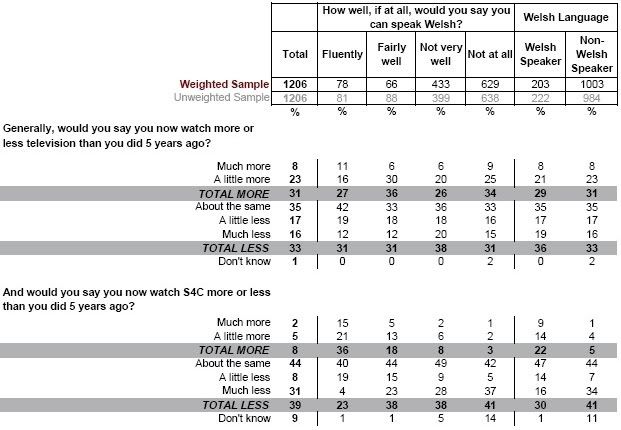
Some of the poll figures which struck me were that:

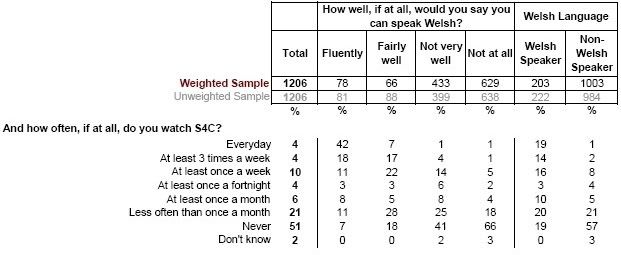
•  19% of Welsh speakers don't watch S4C at all

•  30% watched less TV than 5 years ago, but 39% watched less S4C

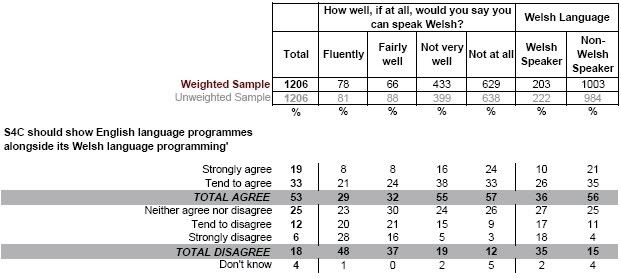
•  35% of Welsh speakers wanted S4C to remain wholly Welsh, but 36% of them thought that it should show English programmes too

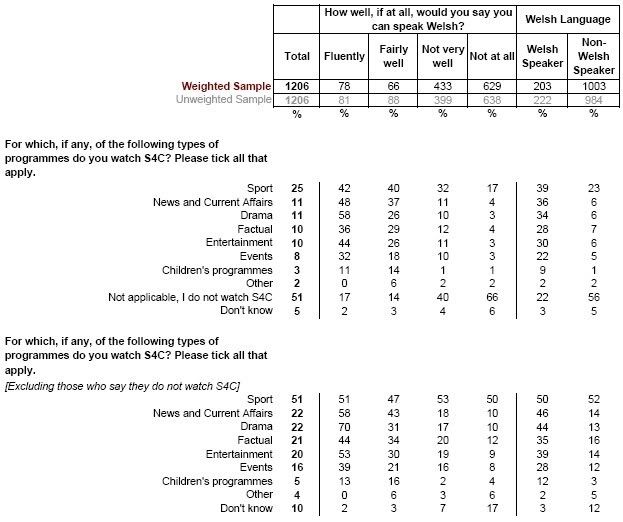
•  Most people watched S4C for its sports coverage

It goes without saying that these were rather disappointing figures. So I asked YouGov for some additional information, particularly because one of the other polls they published based on the same data included a cross-break for fluency in Welsh. ITV have kindly given their permission for YouGov to publish this data and it is now available here.

YouGov in fact asked two separate questions on Welsh, in this order:

Can you understand, speak, read or write Welsh? Please tick all that apply.

•  Understand spoken Welsh
•  Speak Welsh
•  Read Welsh
•  Write Welsh
•  None of the above

How well, if at all, would you say you can speak Welsh?

•  Fluently
•  Fairly well
•  Not very well
•  Not at all

The first question was chosen because it is identical to the question asked in the census, and this was used to weight the raw data, but the second question gives a rather fuller picture of people's ability.

In answer to the first question, 222 out of 1206 or 18.4% said they could speak Welsh, which was then weighted to 16.8%. (If this seems low, it is probably because YouGov asked adults, but the census figures are for all people over 3 years old, and the highest percentage of Welsh speakers is for those at school.) But in answer to the second, the raw percentages for ability to speak Welsh were:

Fluently ... 6.7%
Fairly well ... 7.3%
Not very well ... 33.1%
Not at all ... 52.9%

What this shows is that there is quite a flexible "middle ground" in which people's views can be characterized as falling into one of two responses, either:

"I am a Welsh speaker, but I don't speak Welsh very well."

or

"I don't speak Welsh very well, therefore I can't really call myself a Welsh speaker."

The purpose of giving this explanation is in order to help us understand the more detailed information within the survey. The programme itself only made mention of the breakdown between Welsh speakers and non Welsh speakers based on the first question. In fact it is almost certain that the programme makers did not know what the cross-break (to use the jargon) for fluency in Welsh was, since that information has only been put together in response to my request.

For that reason, I want to stress that I am not accusing ITV of presenting misleading information. The figures they quoted are accurate ... but just not as helpful as they could have been. So with this in mind I now want to look again at what the more detailed information shows us.
 

How many Welsh speakers watch S4C?


So the headline figure that 19% of the Cymry Cymraeg don't watch S4C gets reduced to only 7% of those who speak the language fluently. 93% of fluent Welsh speakers watch S4C at least sometimes, and 71% watch S4C at least once a week.
 

Do we watch S4C more or less that we did 5 years ago?


The way the figures were presented on Y Byd ar Bedwar was that the fall in S4C viewers was worse that the general fall in television viewing. So these more detailed figures are quite startling. Yes, it is true that people generally watch less TV than we did five years ago, but the percentage of fluent Welsh speakers who watch S4C has actually gone up ... 36% watch S4C more than before, only 23% less.
 

What do we watch on S4C?


It is of course true that most people who watch S4C watch it for sport, but for those who are fluent in Welsh, sport is not the main type of programme watched. Drama, News and Current Affairs, and Entertainment programming are each higher up the list than sport.
 

Do Welsh speakers want English language programmes on S4C?


One of the major points made on the programme was that even Welsh speakers, even though only by 36% to 35%, wanted S4C to remain wholly Welsh. But the more detailed figures show that this was certainly not the opinion of those who speak Welsh fluently or even fairly well.

-

I've highlighted these points because they go some way to explain the more surprising figures presented on the programme. S4C is a minority channel, primarily aimed at those who speak Welsh ... although of course open to anybody who wants to watch.

What these figures seem to show is that S4C is actually doing a very good job of providing a range of Welsh language programmes for those who want drama, entertainment, news, current affairs in Welsh rather than in English. The percentage of those fluent in Welsh who watch S4C is very high indeed, and these people watch more S4C now than we used to five years ago. Surely that is a mark of success.

Bookmark and Share
Bookmark and Share
Bookmark and Share

S4C ... Management and Commissioning

In my post yesterday, I focused on the proposed new funding model for S4C, saying that I thought the principle of S4C receiving the bulk of its funding from the television licence fee was acceptable, subject to details about the actual sums of money involved and the need to establish this funding base in the long term. However I think it's worth repeating that I am talking about S4C receiving this money from the TV licence fee directly as a designated, ring-fenced sum. The principle of "top slicing" the licence fee has now been established for some years, and the way I read the DCMS/BBC agreement, it seems clear that this will continue.

He who pays the piper does call the tune. That is why it is important that we establish beyond any doubt that the sums designated to S4C from the licence fee are not the BBC's money, and that the BBC should have no control over how this money is spent. The way to ensure this is to write it into the new legislation rather than rely on the discretion of the parties concerned, and to set out a mechanism for determining what share of the licence fee should be given to S4C in the future.

One of the main reasons I think it's important to deal with funding separately is simple and pragmatic. In any negotiation "principles" and "money" are two terms which are notoriously difficult to separate. So if we can nail down the aspect of funding, it then makes it much easier to talk about the management and commissioning structure through which we get Welsh language television. It also makes sense from the perspective of what is happening politically, for it would be naïve for anyone to think that what has happened in the past few months, or indeed the last few days, has not been almost exclusively motivated by the desire to cut public spending. It is this that the government in Westminster has been primarily concerned about, not the quality or nature of Welsh language television.
 

The problems with the DCMS/BBC agreement

Management and commissioning are matters that certainly do need to be addressed, but the most important thing to note on this subject is that the agreement reached last week is between the DCMS and the BBC, with S4C having no place in the discussions. So even though I don't think it should particularly matter to S4C whether the bulk of its budget comes from government subvention or the television licence fee, I do think that any change to the management and commissioning structure of S4C cannot be decided without reference to them.

For that reason I fully support S4C's decision to seek a judicial review.

But we must be under no illusions about what we expect a judicial review to achieve. In all probability the most that will happen is that the DCMS will be told that it acted precipitously and that it should now undertake a proper consultation. But there will be nothing to stop the DCMS doing that, but then coming to exactly the same decision that it has already taken. The judiciary deals with whether something is lawful or unlawful, and whether the proper procedures have been followed in reaching decisions. We cannot expect any judge to make political decisions.

As I have said a number of times, the Westminster government can do whatever it likes providing it can get a majority to pass the necessary legislation through parliament. It can abolish S4C completely if it can get a bill to that effect through parliament. Therefore the primary focus of our opposition to the Westminster government's proposal must be political. We must persuade MPs that the independence of S4C is of such importance to us that it would be politically unwise of them to push these plans through. That involves protest and demonstrations.

So what arguments should we use? Let's start by looking at the relevant clauses of the DCMS/BBC agreement:

•  Having decided to reduce its own funding for S4C as part of the CSR, HMG holds that a new partnership model with the BBC is the best way of securing the long-term future of the service.

•  There would be a BBC and S4C partnership along similar principles to BBC Alba to begin by 2013/14, with S4C coming under a BBC Trust Service Licence or other operating agreement which would be jointly agreed with the S4C Authority and which would set out the strategic goals and broad editorial requirements of the service.

•  A combined Board of the Authority and Trust would oversee delivery of the Service Licence or operating agreement.

•  The S4C service will be operated by a joint management board with a majority of independent directors, appointed by the BBC Trust and the Authority. The management board will operate its own commissioning structure.

•  Further discussion will be required about the exact form of the partnership, and the Government will play its part in those discussions.

•  The total content commissioning budget will be for independent producers (outside of the BBC's ongoing statutory commitments)

As I read it, this seems to indicate that the DCMS are going to retain the S4C Authority as the body which would receive funds, and that these would come from the television licence fee, a continued but reduced government subvention, and commercial activities. This is reassuring. The changes that are proposed seem not to affect the S4C Authority, but the management of the channel.

-

Now, although we do not know the precise reasons why Iona Jones left as chief executive of the channel, we do know that the S4C Authority made an announcement the very next day saying that it intended to get rid of the "arm's length" separation between the Authority and the channel's management team. This is what it said:

The S4C Authority has announced a change in S4C’s management structure that will lead to a closer working relationship between the Authority and the management team.

S4C Authority Chairman John Walter Jones said that the S4C Authority, the regulatory body that oversees S4C’s performance, would work closer with a leaner management team.

[He] said: “In order to ensure that the Channel’s future remains secure and that the organisation is run efficiently, the most fundamental change is that the concept of due separation between the S4C Authority and the management team will now cease. S4C is a unitary body and this unitary organisation should manage and safeguard the interests of S4C viewers and the Channel’s suppliers in the future.

S4C Authority Press Release, 29 July 2010

It is hard to escape the conclusion that Iona Jones left because she was not prepared to see the erosion of this due separation. It is also hard to escape the conclusion that the DCMS was none too pleased with this ... although that view might be heavily influenced by the BBC who, unlike the DCMS, would have a more informed understanding of the way the industry works. This was an unsavoury episode, made worse by S4C's complete disregard for transparency and the need for a public body to give some sort of public explanation of what was going on behind closed doors.

I don't want to take sides in that dispute, not least because I don't know enough to know what side to take. But it is clear that the Authority felt the need to step in and do the job it had previously entrusted to an arm's length management team. Therefore, if management and commissioning is seen to be a problem, it should come as no big surprise that the DCMS/BBC agreement should address that issue and propose what they think is a better arrangement. Nor should it be surprising that their preferred solution should be one that gives the BBC more control. The BBC are hardly disinterested observers ... they want what suits them. Who wouldn't?
 

The BBC's track record

But we need to be under no illusions that the BBC can be particularly ruthless in pursuit of its own ends, especially when its own back is against the wall. The unilateral announcement that it would cut spending on the Welsh language programmes it provides to S4C from £23.5m to £19.5m is an example of this. It is all the more remarkable because it was made on 8 October ... nearly a fortnight before any decision on the BBC's own funding been reached. It would perhaps be understandable to make such an announcement in response to a decision on BBC funding, but to make such a decision at a time when the BBC's income from the TV licence fee had merely been frozen, not cut, is surely proof enough that Welsh language programming is quite low on the BBC's list of internal priorities.

But if anyone is still not convinced of that, another way of illustrating the same point is to look at what has happened to the BBC's Welsh language output over the last 25 years. As I said last month in this post, when S4C was first set up in 1982 there were only three other free-to-air channels available (BBC1, BBC2 and ITV) plus non-peak Channel 4 programming. In 1982, the BBC broadcast could not have broadcast more than about 36 hours; but now, on one typical day, the BBC broadcasts 139 hours of programming to Wales, i.e. about four times as much as it broadcast in 1982. Although when repeats are taken into account, it might be a little less.

But what has the BBC done to increase its Welsh language output to match its increase in English language output? Well, hardly anything. It has voluntarily increased the programming it provides from 10 to 12 hours a week ... a 20% increase in contrast to its 400% increase in English language programmes. So it is very clear that the BBC doesn't regard itself as being under any sense of moral obligation to treat Welsh and English in the same way.

The lesson to be learned from this is that we cannot entrust the future of Welsh language broadcasting to the BBC. I am sure that there are many individuals within the BBC (and particularly in BBC Wales/Cymru) who do care passionately about it, but this does not extend to the corporation as a whole ... or at least the ranks of its most senior decision makers. Though equally it must be said that the BBC still has major problems coming to terms with adequately reflecting the current political landscape in the UK after more than ten years of devolution.
 

Conclusion

So in conclusion, although there are undoubtedly changes that need to be made to the way that S4C manages the channel and commissions the programmes shown on it, a forced marriage between S4C and the BBC resulting in a joint management and commissioning team is not the right way to go about it.

The principle at stake is plurality. If the editorial choices for all Welsh language broadcasting are made by one "joint management board" operating under one "service licence or operating agreement" then we will only be presented with one view of the world. It won't matter if the joint management board is made up of representatives from S4C, the BBC and a good number of independents. Nor is it a matter of one view being intrinsically better or worse than another ... even the best, most informed view is still only one view.

The BBC makes its own programmes in Welsh. The executive decisions and editorial standpoint of those programmes are for the BBC to decide, subject to its own internal guidelines and procedures. Some will be programmes produced in-house, others will be commissioned from independent producers. This is a good thing. S4C is slightly different in that it commissions all its programmes from independent producers. This is good too. Taken together, we have a model that delivers plurality. So why get rid of it in favour of a new model that by definition cannot and will not be able to deliver plurality?

-

The basic point of principle we must fight for is that the executive decision making and commissioning of programmes in both S4C and the BBC are kept independent of each other, as is currently the case. Of course this does not mean that they can't work together, for the two organizations already have a strategic partnership agreement. Also, there is nothing to stop the two organizations working together in other ways if it is of mutual benefit to them both. If sharing back office functions saves money then of course they should look at ways of doing it. But this is completely different from being forced to work together because it is dictated by badly thought through legislation.

Bookmark and Share
Bookmark and Share
Bookmark and Share

S4C ... The Management and Commissioning Structure

In my post yesterday, I focused on the proposed new funding model for S4C, saying that I thought the principle of S4C receiving the bulk of its funding from the television licence fee was acceptable, subject to details about the actual sums of money involved and the need to establish this funding base in the long term. However I think it's worth repeating that I am talking about S4C receiving this money from the TV licence fee directly as a designated, ring-fenced sum. The principle of "top slicing" the licence fee has now been established for some years, and the way I read the DCMS/BBC agreement, it seems clear that this will continue.

He who pays the piper does call the tune. That is why it is important that we establish beyond any doubt that the sums designated to S4C from the licence fee are not the BBC's money, and that the BBC should have no control over how this money is spent. The way to ensure this is to write it into the new legislation rather than rely on the discretion of the parties concerned, and to set out a mechanism for determining what share of the licence fee should be given to S4C in the future.

One of the main reasons I think it's important to deal with funding separately is simple and pragmatic. In any negotiation "principles" and "money" are two terms which are notoriously difficult to separate. So if we can nail down the aspect of funding, it then makes it much easier to talk about the management and commissioning structure through which we get Welsh language television. It also makes sense from the perspective of what is happening politically, for it would be naïve for anyone to think that what has happened in the past few months, or indeed the last few days, has not been almost exclusively motivated by the desire to cut public spending. It is this that the government in Westminster has been primarily concerned about, not the quality or nature of Welsh language television.
 

The problems with the DCMS/BBC agreement

Management and commissioning are matters that certainly do need to be addressed, but the most important thing to note on this subject is that the agreement reached last week is between the DCMS and the BBC, with S4C having no place in the discussions. So even though I don't think it should particularly matter to S4C whether the bulk of its budget comes from government subvention or the television licence fee (although the amount and the ability to budget for a number of years ahead does matter) I do think that any change to the management and commissioning structure of S4C does matter to S4C and cannot be decided without reference to them.

For that reason I fully support S4C's decision to seek a judicial review. But we must be under no illusions about what we expect a judicial review to achieve. In all probability all that will happen is that the DCMS will be told that it acted precipitously and that it should undertake a proper consultation ... but there will be nothing to stop the DCMS doing that, and then coming to exactly the same conclusion as it has already done. The judiciary deals with whether something is lawful or unlawful, and whether the proper procedures have been followed in reaching decisions. But we cannot expect any judge to make political decisions.

As I have said a number of times, the Westminster government can do whatever it likes providing it can get a majority to pass the necessary legislation through parliament. It can abolish S4C completely if it can get a bill to that effect through parliament. Therefore the primary focus of our opposition to the Westminster government's proposal must be political. We must persuade MPs that the independence of S4C is of such importance to us that it would be politically unwise of them to push these plans through.

So what arguments should we use? Let's start by looking at the relevant clauses of the DCMS/BBC agreement:

•  Having decided to reduce its own funding for S4C as part of the CSR, HMG holds that a new partnership model with the BBC is the best way of securing the long-term future of the service.

•  There would be a BBC and S4C partnership along similar principles to BBC Alba to begin by 2013/14, with S4C coming under a BBC Trust Service Licence or other operating agreement which would be jointly agreed with the S4C Authority and which would set out the strategic goals and broad editorial requirements of the service.

•  A combined Board of the Authority and Trust would oversee delivery of the Service Licence or operating agreement.

•  The S4C service will be operated by a joint management board with a majority of independent directors, appointed by the BBC Trust and the Authority. The management board will operate its own commissioning structure.

•  Further discussion will be required about the exact form of the partnership, and the Government will play its part in those discussions.

•  The total content commissioning budget will be for independent producers (outside of the BBC's ongoing statutory commitments)

As I read it, this seems to indicate that the DCMS are going to retain the S4C Authority as the body which would receive funds from the television licence fee, a continued but reduced government subvention and commercial activities. This is reassuring. The change that is proposed does not affect the S4C Authority, but the management of the channel. Now, although we do not know the precise reasons why Iona Jones left as chief executive of the channel, we do know that the S4C Authority made an announcement the very next day saying that it intended to get rid of the "arm's length" separation between the Authority and the channels management team:

The S4C Authority has announced a change in S4C’s management structure that will lead to a closer working relationship between the Authority and the management team.

S4C Authority Chairman John Walter Jones said that the S4C Authority, the regulatory body that oversees S4C’s performance, would work closer with a leaner management team.

[He] said: “In order to ensure that the Channel’s future remains secure and that the organisation is run efficiently, the most fundamental change is that the concept of due separation between the S4C Authority and the management team will now cease. S4C is a unitary body and this unitary organisation should manage and safeguard the interests of S4C viewers and the Channel’s suppliers in the future.

S4C Authority Press Release, 29 July 2010

It is hard to escape the conclusion that Iona Jones left because she was not prepared to see the erosion of this due separation. It is also hard to escape the conclusion that the DCMS was none too pleased with this ... although that view might be heavily influenced by the BBC who, unlike the DCMS, would have a more informed understanding of the way the industry works. This was an unsavoury episode, made worse by S4C's complete disregard for transparency and the need for a public body to give some sort of public explanation of what was going on behind closed doors.

I don't want to take sides in that dispute, not least because I don't know enough to know what side to take. But it is clear that the Authority felt the need to step in and do the job it had previously entrusted to an arm's length management team. Therefore, if management and commissioning is seen to be a problem, it should come as no big surprise that the DCMS/BBC agreement should address that issue and propose what they think is a better arrangement. Nor should it be surprising that their preferred solution should be one that gives the BBC more control. The BBC are hardly disinterested observers ... they want what suits them. Who wouldn't?
 

The BBC's track record

We need to be under no illusions that the BBC can be particularly ruthless in pursuit of its own ends, especially when its own back is against the wall. The unilateral announcement that it would cut spending on the Welsh language programmes it provides to S4C from £23.5m to £19.5m is an example of this. It is all the more remarkable because it was made on 8 October ... nearly a fortnight before any decision on the BBC's own funding been reached. It would perhaps be understandable to make such an announcement in response to a decision on BBC funding, but to make such a decision at a time when the BBC's income from the TV licence fee had merely been frozen, not cut, is surely all the proof we need that Welsh language programming is quite low on the BBC's list of internal priorities.

But if anyone is still not convinced of that, another way of illustrating the same point is to look at what has happened to the BBC's Welsh language output over the last 25 years. As I said last month in this post, when S4C was first set up in 1982 there were only three other free-to-air channels available (BBC1, BBC2 and ITV) plus non-peak Channel 4 programming. In 1982, the BBC broadcast could not have broadcast more than about 36 hours; but now, on one typical day, the BBC broadcasts 139 hours of programming to Wales, i.e. about four times as much as it broadcast in 1982. Although when repeats are taken into account, it might be a little less.

But what has the BBC done about its Welsh language output? Well, hardly anything. It has voluntarily increased its output from 10 to 12 hours a week ... a 20% increase in contrast to its 400% increase in English language programmes. So it is very clear that the BBC doesn't regard itself as being under any sense of moral obligation to treat Welsh and English in the same way.

The lesson to be learned from this is that we cannot entrust the future of Welsh language broadcasting to the BBC. I am sure that there are many individuals within the BBC (and particularly in BBC Wales/Cymru) who do care passionately about it, but this does not extend to the corporation as a whole ... or at least the ranks of its most senior decision makers. Though equally it must be said that the BBC still has major problems coming to terms with adequately reflecting the current political landscape in the UK after more than ten years of devolution.
 

Conclusion

So in conclusion, although there are undoubtedly changes that need to be made to the way that S4C manages the channel and commissions the programmes shown on it, a forced marriage between S4C and the BBC resulting in a joint management and commissioning team is not the right way to go about it.

The principle at stake is plurality. If the editorial choices for all Welsh language broadcasting are made by one "joint management board" operating under one "service licence or operating agreement" then we will only be presented with one view of the world. It won't matter if the joint management board is made up of representatives from S4C, the BBC and a good number of independents. Nor is it a matter of one view being better or worse than another ... even the best, most informed view is still only one view.

The BBC makes its own programmes in Welsh. The executive decisions and editorial standpoint of those programmes are for the BBC to decide, subject to its own internal guidelines and procedures. Some will be programmes produced in-house, others will be commissioned from independent producers. This is a good thing. S4C is slightly different in that it commissions all its programmes from independent producers. This is good too. Taken together, we have a model that delivers plurality. So why get rid of it in favour of a new model that by definition cannot and will not be able to deliver plurality?

-

The basic point of principle we must fight for is that the executive decision making and commissioning of programmes in both S4C and the BBC are kept independent of each other, as is currently the case. Of course this does not mean that they can't work together, for the two organizations already have a strategic partnership agreement. Also, there is nothing to stop the two organizations working together in other ways if it is of mutual benefit to them both. If sharing back office functions saves money then of course they should look at ways of doing it. But this is completely different from being forced to work together because it is dictated by this proposed new legislation.

Bookmark and Share
Bookmark and Share
Bookmark and Share

S4C ... The Proposed Funding Model

It's taken me a few days to consider all that has happened in the last week regarding S4C. We now have a proposal on the table which we know has been agreed between the DCMS and the BBC, and we know that the Westminster government is minded to impose this proposal on S4C irrespective of what S4C themselves or the Welsh government think of it. This is hardly a satisfactory situation for anyone. All the ingredients are there for a fight, and plenty of people in Wales are up for that fight.

In such a situation, we need to be able to strip away the inessential from the essential, and we need to know what we can reasonably expect and realistically hope to achieve. So I want to set out what I think is reasonable and realistic.

In this post I want to concentrate on the proposed funding model for S4C, and I will address other issues such as its management structure and independence later.
 

The Principle

Whatever the causes of the economic mess we are in, we have to accept that public spending cuts are the primary way in which the elected Westminster government has decided to deal with the UK's deficit; therefore it is pointless to argue that any public service should be immune from spending constraints, and that includes S4C. I think nearly everyone realizes that the funding model, and in particular the link between S4C's grant and inflation, needs to be revisited. The question is how to do it fairly.

My concern is that S4C is not singled out for unfair treatment. It is a public service broadcaster which receives the main bulk of its operating income from public funds, and I have therefore argued that the measure of how fairly it is treated should be to compare it with the BBC, which is in exactly the same position of receiving the main bulk of its income from the licence fee.

So in principle, I positively welcome the proposal to fund S4C from the television licence fee. It is a good idea, because in the long term it ensures parity of treatment between these two public service broadcasters. Provided that S4C's income is linked to the licence fee, it means that S4C cannot be unfairly treated in the money it receives relative to the BBC.

-

But a few things about the TV licence need to be clearly defined. The main thing to be clear about is that it is not the BBC's money. Although the BBC fought for complete control of the money raised from it, their fight against "top slicing" the licence fee was lost some years ago when a proportion of it was set aside for the digital switchover. I'm sure the BBC hoped this might prove to be only a temporary arrangement. But we just need to look in detail at some of the points in the agreement just reached between the BBC and the DCMS.

•  The current ring-fence of approximately £133m per annum will be raised to, and capped at, £150m per annum from 2013/4 to 2016/17 but re-purposed for broadband, consistent with the BBC’s public purposes.

•  The BBC will play an active role in supporting new local television services through a partnership fund providing capital costs of up to a total of £25m in 2013/14 for up to twenty local TV services, subject to any necessary regulatory approval. The BBC will also commit to ongoing funding of up to £5m per annum from 2014/15 to acquire content for use on its own services from these new services. Should capital costs be required earlier then this will be facilitated by access to the existing digital switchover underspend by mutual agreement.

So money from the licence fee is going to continue to be given directly to non-BBC organizations. In other words the principle of top slicing the TV licence fee is now firmly established.

-

When it comes to funding S4C, there are several sections of the agreement which provide an equal guarantee of this ring-fencing:

•  In 2013/14 and 2014/15, the BBC will contribute £76.3m and £76m respectively in cash in addition to its statutory commitments [i.e. the 10 hours per week of original programming]

•  In the event that a new partnership model does not prove viable for any reason, the Government will not take licence fee money itself for this purpose. But in this situation the Trust will propose a one-off reduction in the level of the licence fee which would be equivalent to the contribution that the BBC would otherwise have made to S4C.

Contrary to what some others have said, I think this last point is enlightening and reassuring. It sets out the principle that S4C's part of the licence fee does not belong to the BBC, and will not revert to the BBC if this proposed funding model breaks down. Elsewhere, the agreement says this:

•  Under the partnership, funding for S4C in future will come from three sources: the licence fee, a continued but reduced subvention from the Government, and commercial income

So it seems quite clear that S4C will continue to exist as an entity in its own right; but that, after a transition period, it will receive the bulk of its income from the licence fee (note that the agreement does not say "from the BBC") and will continue to receive a much smaller sum from the government, as well as its commercial income. Therefore, so far as the principle of the proposal to revise S4C's sources of funding is concerned, I don't have a problem with it. There are other things to fight about, but in my opinion we should not fight about this.
 

The Detail

However there are two points of detail about funding that should cause us considerable concern.

The first is about the the actual sums of money involved. It is not reasonable to expect S4C to be treated in a worse fashion than the BBC. So we should fight to make sure that it is not, and fully expect to win that fight.

The situation is not helped by a certain lack of objectivity, optimism, or simple spin coming from some quarters. In the video of the Westminster hall debate on Wednesday, Alun Cairns had the audacity to call this proposed funding settlement "generous" to S4C. And in this post on his blog, Glyn Davies said that the only organization "with a genuine grouse that has real credibility" is the BBC. I'm sorry to say that neither of these assertions stands up to scrutiny.

As the BBC/DCMS agreement makes clear, the additional responsibilities that the BBC have agreed to take on are equivalent to a reduction in income of 16%. However the cuts proposed for S4C result in a loss of DCMS funding of 24%. I think we have a good case to fight for the reduction of funding form the DCMS to be 16% rather than 24%.

Now there are a number of ways of doing the maths, particularly when commercial activities are taken into account. But the difference is likely to be less than £10m. In terms of the DCMS budget of over £2bn and the BBC's budget of maybe £3.5bn this is peanuts, but £10m is a much more significant amount for S4C.

The second detail yet to be worked out is how to safeguard S4C's funding in future years, as this Comprehensive Spending Review only covers four years, and the TV licence fee is only set for six. In my view, the most equitable way of solving the problem is for S4C to receive a fixed proportion of the TV licence fee each time it is renegotiated. If it goes up, so will S4C's income from this source; if it goes down, so will S4C's income ... but it will mean that these two public service broadcasters are treated equally. The bottom line is that each round of licence fee negotiations in future must clearly define the sum that is to be paid to S4C. We must ensure that this is built into the new legislation now.

-

In discussing funding, my basic premise has been that it really doesn't matter to S4C whether it gets the bulk of its income by direct subvention from government or from the TV licence fee. Money is just money. We should accept that there needs to be a cut because everything else is being cut, but we should not expect S4C to suffer more of a cut than the BBC. A small adjustment of less than £10m per year should ensure this.

But the management of S4C is another matter entirely.

S4C needs to remain as an independent entity, and we must fight tooth and nail to make sure that its management structure and editorial independence is not subsumed into the BBC. This post is long enough, so I'll say more on that subject in the next.

Bookmark and Share
Bookmark and Share
Bookmark and Share

Ignoring Wales

A GUEST POST BY MADOC BATCUP

Madoc Batcup is an independent financial
consultant and director of Wales in London.

 
On the 21st May 2010 Radio 4's Any Questions hosted by Jonathan Dimbleby came to Gowerton to make their broadcast. You might have been forgiven for thinking that Gowerton was in Chesham and Amersham, the constituency of the new Secretary of State for Wales, for all the Welsh content that it had. None of the panellists came from Wales and none of the questions were in respect of Wales. Indeed, Wales was considered so denuded of anybody of sufficient ability to answer the questions that Grant Shapps, the housing minister with a pilot’s licence, was asked to fly himself to Swansea airport (presumably at licence payers' expense) to make up the numbers on the panel.

In addition we had the interesting spectacle of one of the questioners saying that although he had been "given a question to ask" he wanted to ask one of his own, thereby begging a number of questions as to the criteria used to select the questions in the first place.

At a time when there may be a referendum on additional powers for the Welsh Assembly later on this year, when there has been an announcement that the unfair Barnett funding formula for Wales will remain in place, and when there are now different parties/coalitions in power in Wales and in Westminster for the first time, there was no lack of potential questions with a Welsh dimension relevant to the UK as a whole. Indeed the fact that Wales has had a coalition government for three years might have been the subject of a question in terms of what Westminster could learn from the Welsh experience.

-

Of course this is not an isolated incident. The television programme Question Time hosted by the other half of the Dimbleby combo, David, was broadcast from Cardiff on the 25th February. Although on that occasion two of the panellists were Welsh MPs, no questions in respect of Wales were asked, although two that related almost exclusively to England (including one on the English football team) were.

More than a decade after devolution it is extraordinary that in the very programmes have pretensions to be less metropolitan in their approach by travelling around the UK, the BBC continues to flagrantly breach its own interpretation of its obligations of a public sector broadcaster.

In the BBC's Programme Response to Devolution published in December 1998, the BBC stated that:

In the past the BBC has sometimes appeared insensitive to political, administrative, cultural and linguistic differences across the UK, giving the impression of a London-based organisation dismissive of the more geographically distant parts of the UK. There have been errors of judgement and, on occasions, of accuracy.

As a priority, the BBC is now embarking on an extensive series of measures to educate journalists, programme makers and managers, alerting them to the differences across the UK ... they will include:

•  Regular monitoring of programmes for sensitivity to differences between the nations.

These measures are important not only to enable the BBC to provide accurate and well judged news for its audiences in Scotland, Wales and Northern Ireland but also to allow it to offer all viewers and listeners a true sense of the diversity within the UK.

Clearly the Any Questions programme from Gowerton failed to "offer all viewers and listeners a true sense of the diversity within the UK".

Clause 4(d) of the BBC Charter, states:

The Public Purposes of the BBC are as follows:

... (d) representing the UK, its nations, regions and communities.

Under the Agreement between the BBC and the UK government, signed at the time of the renewal of the BBC's Charter in July 2006, the BBC undertook a number of commitments in respect of this Charter Principle, for example:

In developing (and reviewing) the purpose remit for representing the UK, its nations, regions and communities, the Trust must, amongst other things, seek to ensure that the BBC —

... (b) promotes awareness of different cultures and alternative viewpoints, through content that reflects the lives of different people and different communities within the UK.

Under the Public Purpose Remit "Representing the UK, its nations, regions and communities" published by the BBC Trust in 2007, the BBC undertakes to "represent the different nations, regions and communities to the rest of the UK" and also to "cater for the different nations, regions and communities of the UK."

It is clear therefore that the BBC has committed itself to ensuring that the interests of the different parts of the UK are reflected in its output, and that the rest of the UK is able to be informed about the differences of distinct regions and nations of the UK.

In addition the BBC Trustees commissioned a report on this very issue which was published in 2008, entitled "The BBC Trust Impartiality Report: BBC Network News And Current Affairs Coverage of the Four UK Nations", popularly known as the King Report, after its author. This incorporated research done by Cardiff University.

The report noted inter alia that:

Notwithstanding examples of good practice, however, and supported by findings from the Cardiff research, the review highlights concern that BBC network news and current affairs programmes taken as a whole are not reporting the changing UK with the range and precision that might reasonably be expected given the high standards the BBC itself aspires to. There are specific concerns as to accuracy and clarity of reporting, the balance of coverage, and missed opportunities of drawing on the rich variety of the UK and communicating it to multiple audiences.

As examples, political coverage is seen as unduly focused on Westminster in volume and style; there is seen to be a general bias in favour of stories about England or telling stories from an England perspective; and there is evidence that several stories in the nations which may have been significant to the UK were not taken up by the network. Overall, Professor King concludes that the BBC has not responded adequately and appropriately to the UK’s changing political, social, economic and cultural architecture. In the closing sections of his report, he offers a range of suggestions and issues for consideration in resolving the concerns he has highlighted.

In its concluding comments on the report the BBC Trust stated:

However, we are concerned at Professor King’s assessment that the BBC is not reporting the changing UK with the range that might be expected, given the fact that audiences have expressed a desire to learn more about other parts of the UK in the BBC’s coverage. This echoes a wider concern expressed to the Trust that audiences see the BBC as too preoccupied with the interests and experiences of London, and that those who live elsewhere in the UK do not see their lives adequately reflected on the BBC. It is not acceptable that a BBC funded by licence fee payers across the whole country should not address the interests of them all in fair measure.

We are also concerned at the finding by Professor King that there is insufficient precision and clarity in the BBC's network coverage. The BBC's output must meet the high standards expected by the licence fee payer. It is essential that accurate information about political developments in the four nations is reflected in network news and current affairs so that the authority of the voice of the BBC is maintained, and the audience has confidence in that voice. To achieve full accuracy, the audience needs to be made aware by clear labelling which facts are applicable to which nations of the UK.

Some two years after the King Report the BBC is still failing to comply with the recommendations of the BBC Trust and nearly 12 years after its document "Programme Response to Devolution" it is still failing "to offer all viewers and listeners a true sense of the diversity within the UK".

Part of the problem may lie in the way the BBC measures its compliance of its public service obligation. Under its Operating Remit of 2007 it states that, "the Trust will use a system of quantitative measures." It is not so much the validity of the complaint as the quantity of complaints that is measured it would seem. I would therefore suggest that anyone who feels that the current situation is unsatisfactory after a period of twelve years of broken commitments should complain to http://www.bbc.co.uk/complaints/homepage where Sir Michael Lyons confirms that "your complaint is important to us."

The attitude of the Any Questions? programme in respect of Wales is, I think, emblematic of a more fundamental metropolitan mindset in the BBC; reflected for example in their approach to the last general election and the broadcasting of the leadership debates. The lavish salary structures of BBC executives and the inability of the BBC Trust to ensure the BBC provides an understanding of the devolution settlement across the UK raises serious questions as to whether the BBC is sufficiently accountable. As the new UK government starts to take the knife to the civil service the question is how, and by whom, will the BBC, privileged as it is to impose an annual flat tax on television usage, be taken to task to ensure it honours its commitments?

Bookmark and Share
Bookmark and Share
Bookmark and Share

Complaint about BBC Question Time

COPY OF A LETTER FROM MADOC BATCUP TO THE BBC
REGARDING QUESTION TIME FROM CARDIFF, 25 FEBRUARY 2010

Dear Sir/Madam

I am writing to complain about Question Time from Cardiff which was broadcast last night. It is a programme that seems to be in some pre-devolution timewarp. Whatever internal measures the BBC make have taken following the King Report none of them seemed to be apparent in your recent programme – in great contrast to the Question Time broadcast from Northern Ireland recently.

The choice of the panel left a great deal to be desired with two of the panellists (Nigel Farage and Liam Fox) having no discernible connexion with Wales, while Janet Street Porter's family links to Wales and previous antagonistic comments on the Welsh language and Burberry's did not seem particularly relevant to the debate or the current situation in Wales.

As a result of the panel's composition, it was noticeable that there was no representation from the Liberal Democrats, and the ability of some of the panel members to discuss matters of specifically Welsh interest was somewhat limited. Fortunately for them, of course, they did not have to do so.

The questions themselves seem to have been very heavily filtered (on the assumption that they were not planted) and failed to address any fundamental Welsh political issues. On the contrary, the two questions about the behaviour of Gordon Brown and Nigel Farage did not (as pointed out by a member of the audience) advance in any way the argument of whom to vote for in the forthcoming election. UKIP is the only party that wishes to abolish the Welsh Assembly as far as I am aware, and it would have been much more informative to ask Nigel Farage something about his party's policy in respect of Wales. We were then treated to the extraordinary spectacle of a question of legislation on faith schools which is of limited relevance to Wales, since this is a devolved matter (e.g. see the parliamentary website http://www.commonsleader.gov.uk/output/page2921.asp and its comments on devolution in respect of this legislation). This is a perfectly appropriate matter to discuss, but why in one of the parts of the UK where it will largely not be applicable? Can we expect questions about Scottish and Welsh legislation to be discussed by English Question Time panels in the future, or is this yet another case of Wales being treated as a part of England by the BBC and the issue of devolution being studiously ignored?

To add insult to injury we then had a question about the England football team. It is incomprehensible to me why it was thought such a question was appropriate to be asked in Cardiff. A number of the members of the audience and Elfyn Llwyd made it quite clear that it was a question of little interest to people in Wales. Can we expect questions about Welsh rugby from Newcastle or Basingstoke in the future? At a time when the Welsh Assembly has just voted unanimously to ask for more powers through a referendum, wouldn't this have been an appropriate occasion to discuss this issue, since the majority of your English viewers may be unaware that this potentially historic event even took place. Since it is probably the last time that Question Time will visit Wales prior to the Westminster election it would have a useful opportunity to discuss issues that are of particular relevance to Wales in the same way as the Question Time broadcast from Northern Ireland focused on that part of the UK.

In the BBC's Programme Response to Devolution published in December 1998, the BBC stated that:

In the past the BBC has sometimes appeared insensitive to political, administrative, cultural and linguistic differences across the UK, giving the impression of a London-based organisation dismissive of the more geographically distant parts of the UK. There have been errors of judgement and, on occasions, of accuracy.

As a priority, the BBC is now embarking on an extensive series of measures to educate journalists, programme makers and managers, alerting them to the differences across the UK ... they will include:

•  Regular monitoring of programmes for sensitivity to differences between the nations.

These measures are important not only to enable the BBC to provide accurate and well judged news for its audiences in Scotland, Wales and Northern Ireland but also to allow it to offer all viewers and listeners a true sense of the diversity within the UK.

Although this paragraph related to news programmes the document as a whole deals with news and current affairs, and I assume that the BBC would have the same goals for a programme like Question Time. Whatever measures you may have taken there appears, in the case of this recent programme, to have been no discernible effort to meet the BBC's diversity goal. This programme could just as easily (and more appropriately) have been transmitted from Norwich or Manchester for example. It is a clear indication that any changes that the BBC may have made in respect of reflecting the reality of the diversity of the UK have been wholly inadequate. This programme represented a total failure by the BBC of making the viewers in Wales or the wider UK aware of the important political issues that are distinctive to Wales at a time when there is a Westminster election in the offing. If the BBC wishes to patronise and ignore Wales in equal measure it is a waste of licence payers' money for it to do it locally – it can do this just as easily from London and stop the pretence that Question Time has any meaningful interest in the issues of Wales by broadcasting from Wales.

Yours faithfully

Madoc Batcup


Bookmark and Share
Bookmark and Share
Bookmark and Share